Why Resistors Get Hot: Power, Ratings and Heat
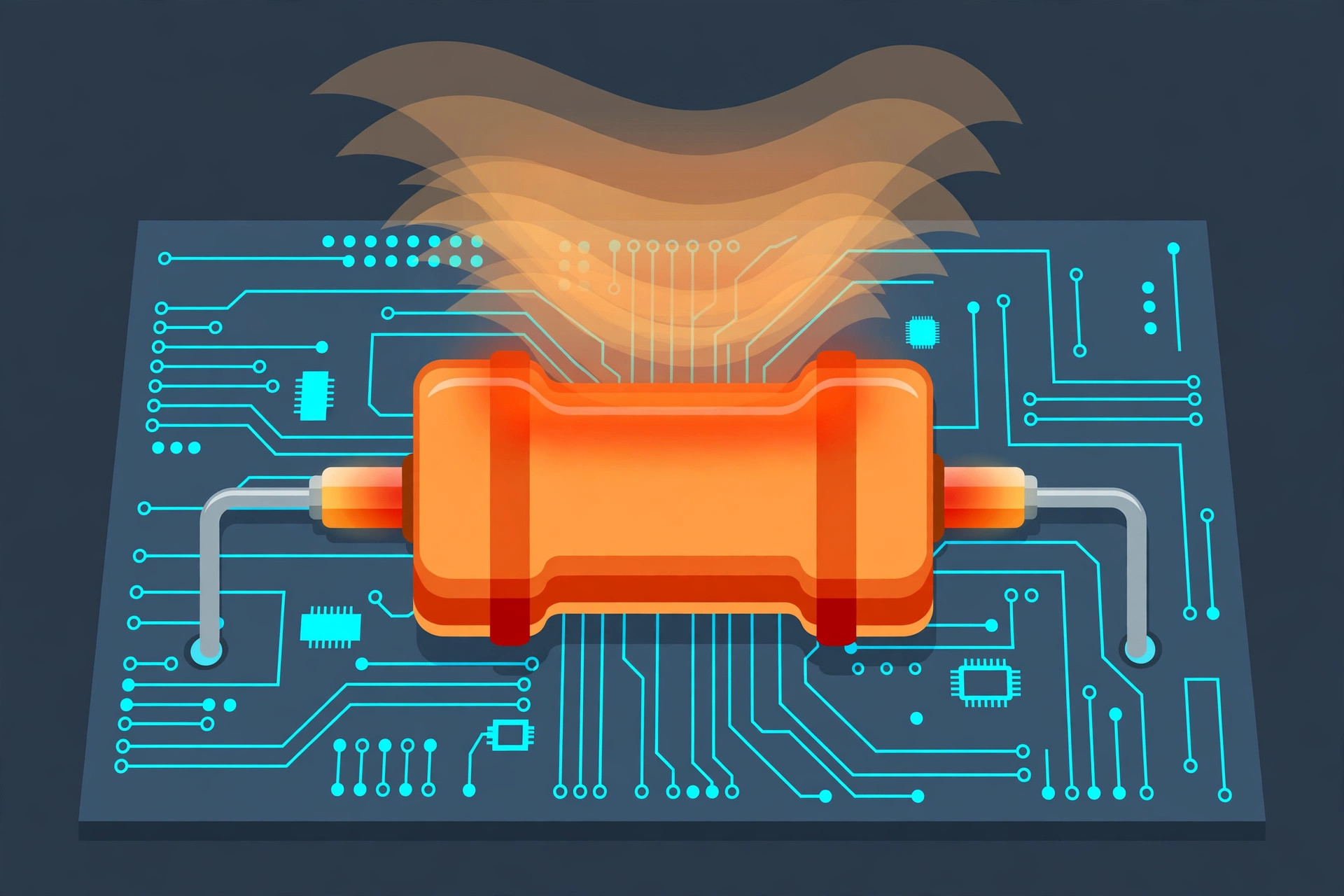
Every resistor is a small heater
Electrical power delivered to a resistor leaves as heat, all of it. The power is the current squared times the resistance, or the voltage squared divided by the resistance, two faces of the same law. A resistor carrying modest current at low voltage may warm by a fraction of a degree, while the same body style dropping a large voltage can reach temperatures that discolour the circuit board beneath it. This conversion, called Joule heating after James Prescott Joule, is a nuisance in signal circuits and the entire point in heaters, kettles and the glowing element of an old filament lamp.
Wattage ratings and derating
A resistor's wattage rating is not the power it uses but the power it can survive, under stated conditions, usually free air at room temperature. Run a quarter watt part at a quarter watt and it will be uncomfortably hot to touch; experienced designers use at most half the rating for long life, and less inside a sealed box or a hot climate. Datasheets show derating curves that reduce the allowed power as ambient temperature climbs. Physical size tracks rating because a bigger body has more surface to shed heat, which is why power resistors look like bricks beside their signal-level cousins.
When heat becomes failure
Overheated resistors drift in value, crack their coating, and can char the board or ignite nearby dust and plastic in the worst cases. Heat is also information: a component running unexpectedly hot is often the first symptom of a fault elsewhere, a shorted output or a dried-out capacitor raising the load. Fingers are crude thermometers but honest ones, and a thermal camera turns fault-finding into watching the guilty part glow. The Joule heating calculator shows the power and total heat for any current and resistance, so you can check a part's rating before the circuit ever warms up in anger. Heat leaves a resistor three ways: conduction into its leads and the board, convection into the air, and radiation, in roughly that order of importance for small parts. This is why mounting matters. A power resistor bolted to a chassis or standing clear of the board on long leads runs far cooler than the same part hugged flat inside a sealed plastic box. Designers also parallel or series several resistors to share a dissipation no single stock part should carry alone, checking each share with the power formulas rather than assuming equality. And when you meet a resistor that has run hot for years, expect its value to have wandered upward and its bands to have browned: heat writes its history on the part, for those who read it.
Try the numbers yourself
The free calculator that goes with this guide:
Open the Joule heating calculator