What Is Capacitance? Storing Energy in an Electric Field
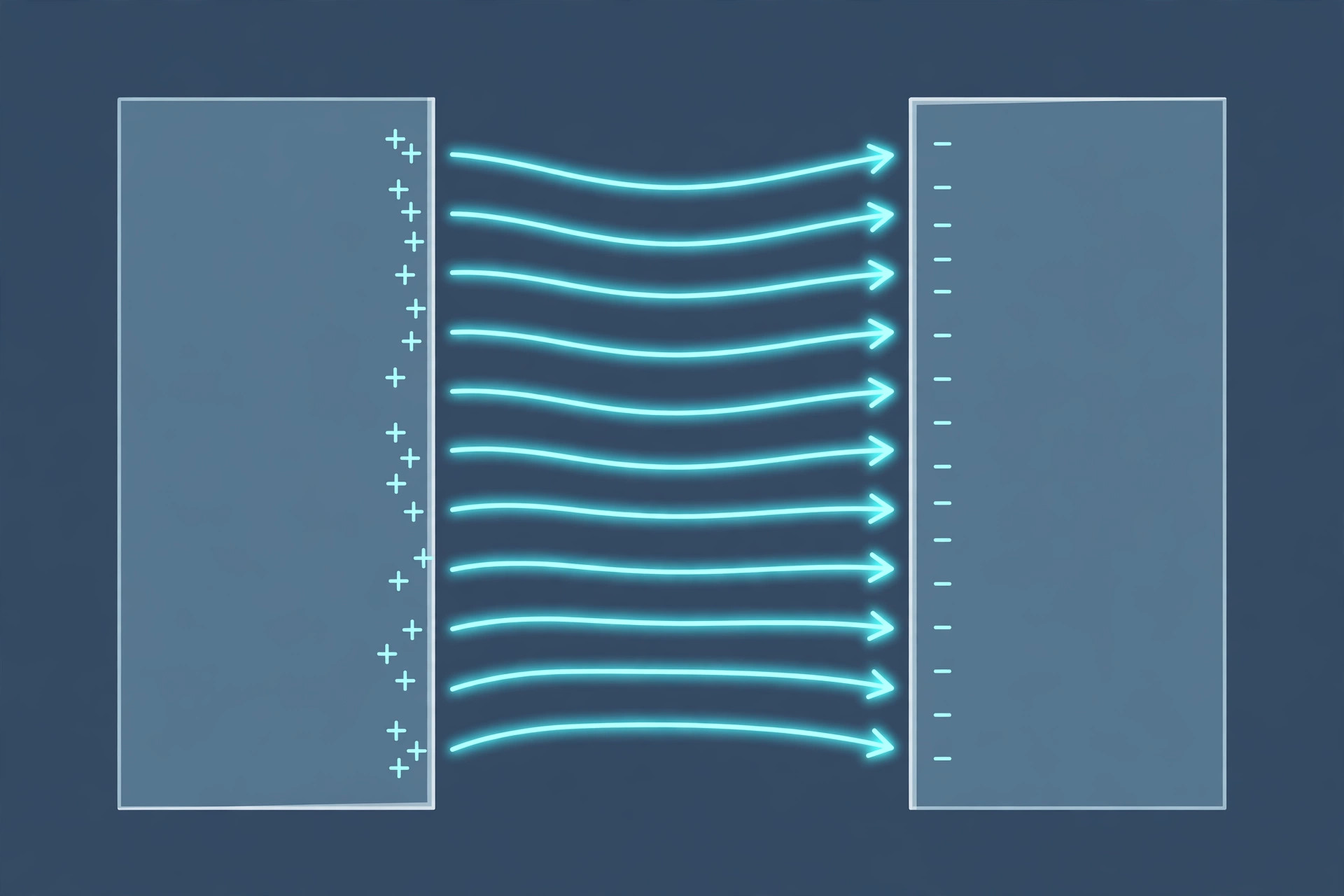
Two plates and an electric field
A capacitor stores energy in an electric field between two conducting plates separated by an insulator, the dielectric. Capacitance measures how much charge the plates hold per volt applied: one farad is one coulomb per volt, an enormous amount, which is why real parts come in microfarads, nanofarads and picofarads. Bring the plates closer or make them larger and capacitance rises; slide in a dielectric with a high permittivity and it rises again. The classic demonstration Leyden jar held a nanofarad or so and could knock a line of soldiers off their feet, which says more about voltage than capacity.
Charging, discharging and blocking DC
Connect a capacitor to a supply through a resistor and charge flows until the capacitor voltage matches the supply, quickly at first, then ever more slowly. Once charged, a capacitor blocks steady direct current entirely, which makes it the standard tool for passing a signal while blocking a DC level. Reverse the picture for alternating current: the capacitor charges and discharges continuously, passing AC with an opposition, reactance, that falls as frequency rises. That single behaviour explains most capacitor jobs in electronics: smoothing, coupling, decoupling, timing and filtering all grow out of it.
The main families and their trade-offs
Ceramic capacitors are small, cheap and stable enough for decoupling and RF work, but their capacitance can fall sharply with applied voltage in some dielectrics. Film parts are accurate and low-loss for audio and timing. Aluminium electrolytics offer the most capacitance per size and per penny, at the cost of polarity, leakage and a finite life as their electrolyte slowly dries, the commonest cause of death in ageing power supplies. Supercapacitors trade voltage for staggering capacitance measured in farads. Choosing is a balance of value, voltage rating, tolerance, loss and size, and the series and parallel rules here help you combine stock values into the one you need. Two ratings ride along with every capacitor and ignoring either is expensive. The working voltage is a hard ceiling, and prudent design keeps a third in reserve because surges exist and electrolytics age. The ripple current rating on power supply parts limits the internal heating that shortens life. Tolerance is the third quiet figure: a ceramic part marked 100 nanofarads may honestly measure anywhere in a wide band depending on its dielectric class, which is fine for decoupling and useless for a precision filter, where film or a stable ceramic class is chosen instead. Capacitance also changes with conditions in some families, falling with applied DC voltage in high-density ceramics, one more reason the value printed on the can is the start of a datasheet conversation, not the end.
Try the numbers yourself
The free calculator that goes with this guide:
Open the capacitor calculator