Series and Parallel Battery Packs: Voltage, Capacity and Weak Cells
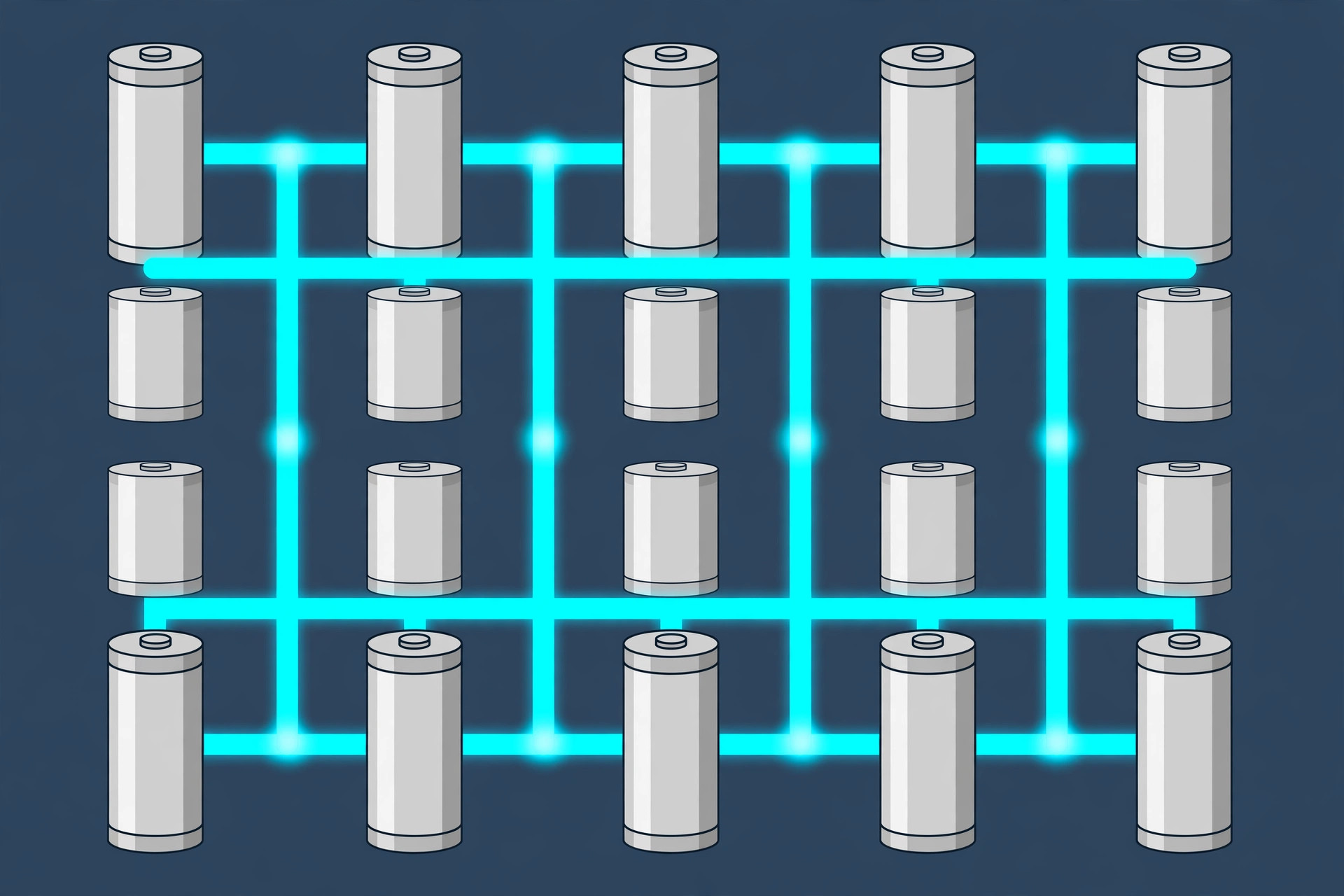
Two ways to combine, two different results
Cells in series stack their voltages while the capacity in amp-hours stays that of one cell: four 3.7 volt cells in series make a 14.8 volt pack. Cells in parallel keep the voltage of one cell and add their capacities: two 2.5 amp-hour cells in parallel give 5 amp-hours. Combine both and you get the S and P notation of the lithium world, so a 4S2P pack has eight cells arranged as four series pairs of two. Energy in watt-hours is the great leveller: multiply pack voltage by pack amp-hours and every configuration of the same cells holds the same total energy.
Why packs are only as strong as their weakest cell
In a series string the same current flows through every cell, so the cell with the least capacity empties first and can be dragged below its safe voltage by its stronger partners, while on charge it fills first and can be pushed too high. This is why pack builders match cells by capacity and internal resistance, why battery management systems watch individual cell voltages, and why a single tired cell can retire a whole laptop or tool battery. Parallel groups are more forgiving, since the cells share current and balance each other, though a shorted cell in a parallel group becomes everyone's problem.
Building and buying with the numbers
Start any pack design from the load: the voltage it needs sets the series count, the running time sets the parallel count, and the peak current checks that the cells' discharge ratings add up to the job. Fuses, balance leads and a proper management board are part of the pack, not accessories, and salvaged cells of unknown history have no place in a pack that sleeps in your house. The pack calculator gives the voltage, capacity, energy and cell count for any S and P arrangement, the four numbers every pack conversation starts from. Protection is the difference between a pack and a hazard, and it scales with the arrangement. Series strings need their total voltage and each cell watched, because the string charger sees only the sum while individual cells drift apart over cycles. Parallel groups need fusing thought through, since a failed cell can be fed by all its partners at once. Builders of large packs, for vehicles and home storage, add cell-level fusing, temperature sensors and contactors, layers that all descend from the same arithmetic the calculator performs: how many cells, in what arrangement, holding how much energy, delivering how much current. Start every pack conversation with those four numbers and the safety engineering has somewhere solid to stand.
Try the numbers yourself
The free calculator that goes with this guide:
Open the battery pack calculator