Series and Parallel Resistors: Two Rules That Cover a Lot of Ground
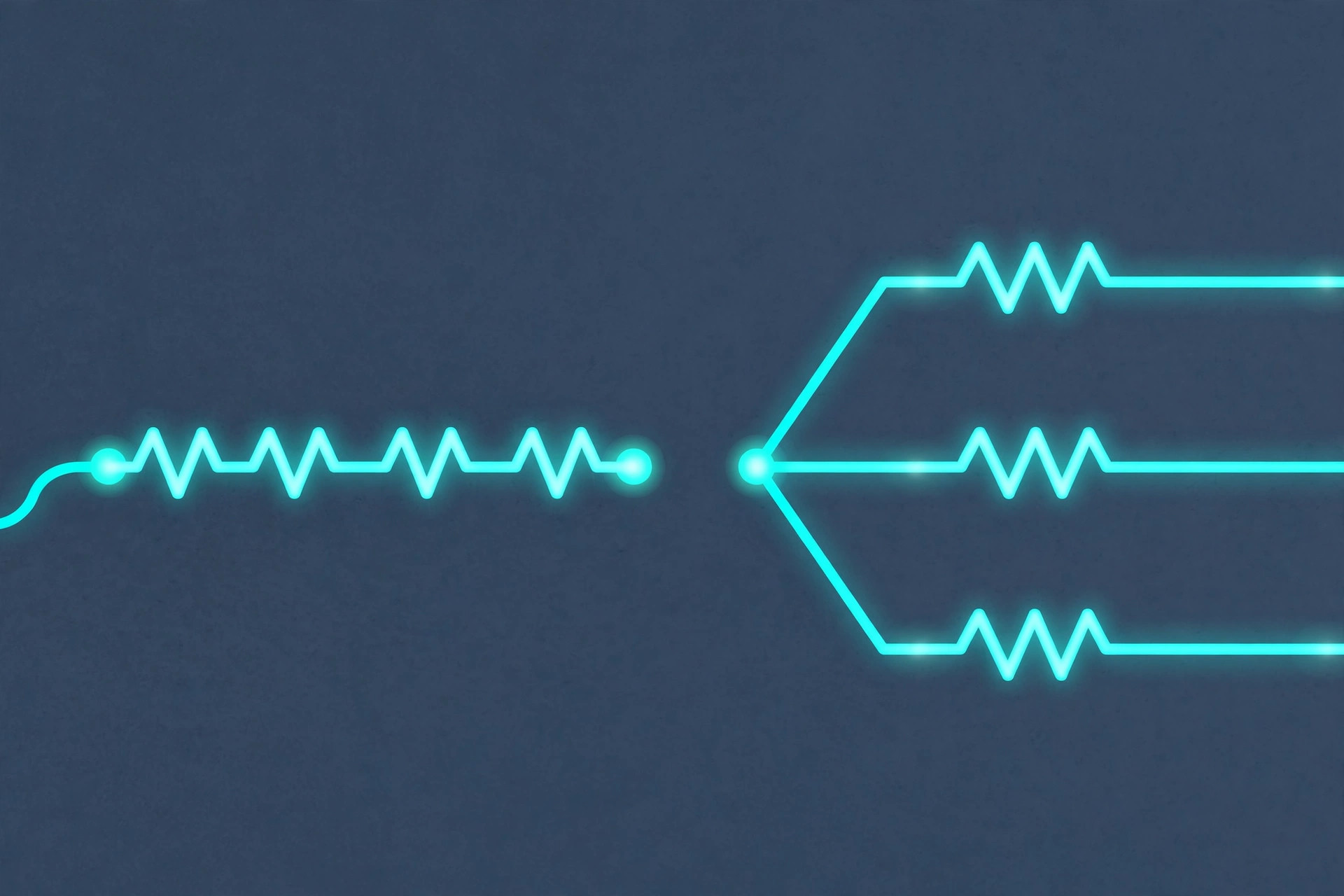
Series: one path, values add
Resistors in series sit on a single path, so the same current must pass through each one in turn. Each resistor drops part of the voltage, and the drops add up to the supply voltage. Because the total opposition is the sum of the parts, the combined resistance is simply R1 + R2 + R3. This is how you make a non-standard value from standard ones, and it is also why a chain of resistors can share a high voltage that would overwhelm a single part. The largest resistor in the chain drops the largest share of voltage and usually dissipates the most power, which is worth checking before you build.
Parallel: many paths, total falls
Resistors in parallel share both ends, so each carries the full voltage and draws its own current. The total current is the sum of the branch currents, which makes the combined resistance lower than any single branch: 1/R = 1/R1 + 1/R2 and so on. Two equal resistors give exactly half; a 100 ohm and a 10 ohm in parallel give about 9.1 ohms, dominated by the smaller one. This behaviour is why parallel combinations are used to increase power handling, since the current and the heat split between the parts, roughly in inverse proportion to their values.
Networks: reduce them step by step
Real circuits mix the two. The method is always the same: find a group that is purely in series or purely in parallel, replace it with its single equivalent value, redraw the circuit, and repeat until one resistor remains. Work from the far end of the network towards the source. If a group is neither purely series nor purely parallel, it shares a node with something else, so look for a smaller group first. The calculators here handle the two basic rules for any list of values, which makes checking each reduction step quick. With the equivalent resistance known, Ohm's law gives the total current, and you can walk the voltages and currents back through the original network. Power deserves a word before you solder. In series, the largest resistor drops the most voltage and usually dissipates the most power, since the current is shared and power follows I squared R. In parallel, the smallest resistor draws the most current and works hardest, because power follows V squared over R. Faults behave differently too: a series chain fails open and silent when one part breaks, stopping everything, while a parallel bank limps on at a changed value when one branch opens, which is why critical shunts and heater banks are paralleled deliberately. When you combine values to hit a target, run the combination through the calculators and check each part's share of the power, not just the total resistance.
Try the numbers yourself
The free calculator that goes with this guide:
Open the parallel calculator