Reactance Explained Simply: Resistance With a Frequency Knob
Opposition that depends on frequency
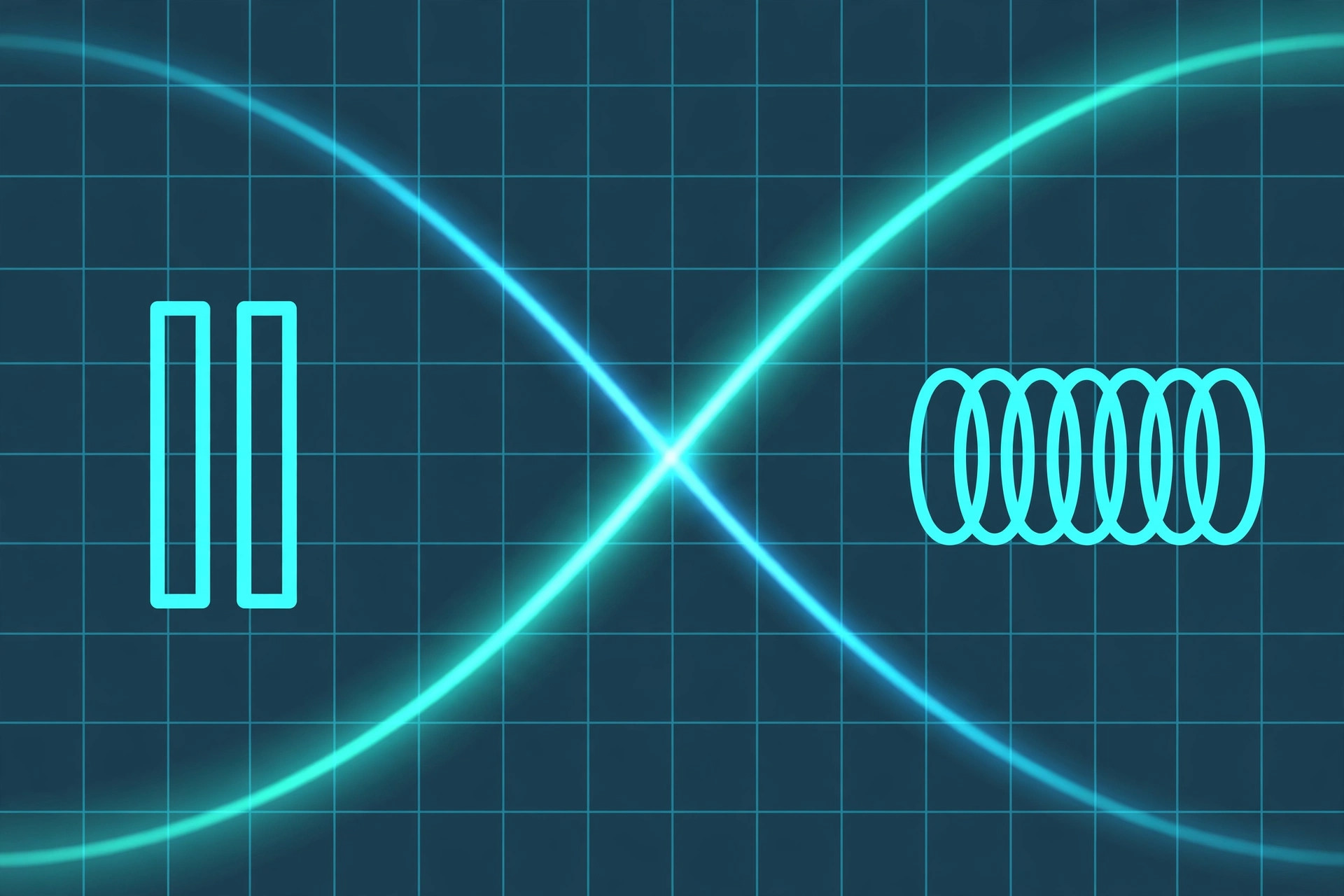
Resistance is steady: a 100 ohm resistor opposes direct and alternating current alike. Capacitors and inductors behave differently. Their opposition, called reactance, changes with frequency, and it stores and returns energy rather than dissipating it as heat. Capacitive reactance falls as frequency rises, from near infinity at DC, where a capacitor blocks steady current entirely, down towards zero at high frequencies. Inductive reactance does the opposite, starting near zero for DC and climbing steadily. Plotted together the two curves cross at exactly one frequency, and that crossing is resonance, the most useful accident in radio engineering.
The formulas and what they teach
Capacitive reactance is 1 / (2 pi f C); inductive reactance is 2 pi f L. Both are measured in ohms and both reward a feel for the numbers. A 1 microfarad capacitor at 50 hertz mains frequency offers about 3,200 ohms, which is why small capacitors can drop mains voltage in cheap transformerless supplies, a trick that is clever and unforgiving in equal measure. At 1 megahertz the same capacitor offers a sixth of an ohm, effectively a wire. A 10 millihenry choke at audio frequencies is a mild presence; at radio frequencies it is a wall. Choosing a component is often just choosing where on these curves you want to stand.
Reactance at work
Reactance is the working principle behind tone controls, crossovers that send bass to woofers and treble to tweeters, radio tuning, and the blocking capacitors that let a signal hop between stages at different DC levels. Combined with resistance it forms impedance, the total opposition in an AC circuit, where the parts add as vectors rather than plain numbers because the voltage and current in a reactance are a quarter-cycle out of step. That phase shift is not a detail: it is why power factor exists and why filters shape signals in time as well as size. The reactance calculator gives both values at any frequency, ready for filter and resonance work. One consequence deserves its own paragraph because it powers a continent of equipment: because a capacitor's reactance is predictable, a capacitor can stand in for a resistor in dropping voltage from the mains, without getting hot the way a resistor would. This capacitive dropper feeds countless cheap supplies in appliances and LED lamps. Its efficiency is real and so are its hazards: the circuit it feeds is not isolated from the mains, the capacitor must be a safety-rated class X part, and the current it passes depends on the load behaving itself. Treat any such supply as live in every corner. The same reactance that performs this trick is what the calculator reports, in ohms, ready to be designed with rather than guessed at.
Try the numbers yourself
The free calculator that goes with this guide:
Open the reactance calculator