The RC Time Constant in Practice: The 63 Percent Rule
One number that sets the pace
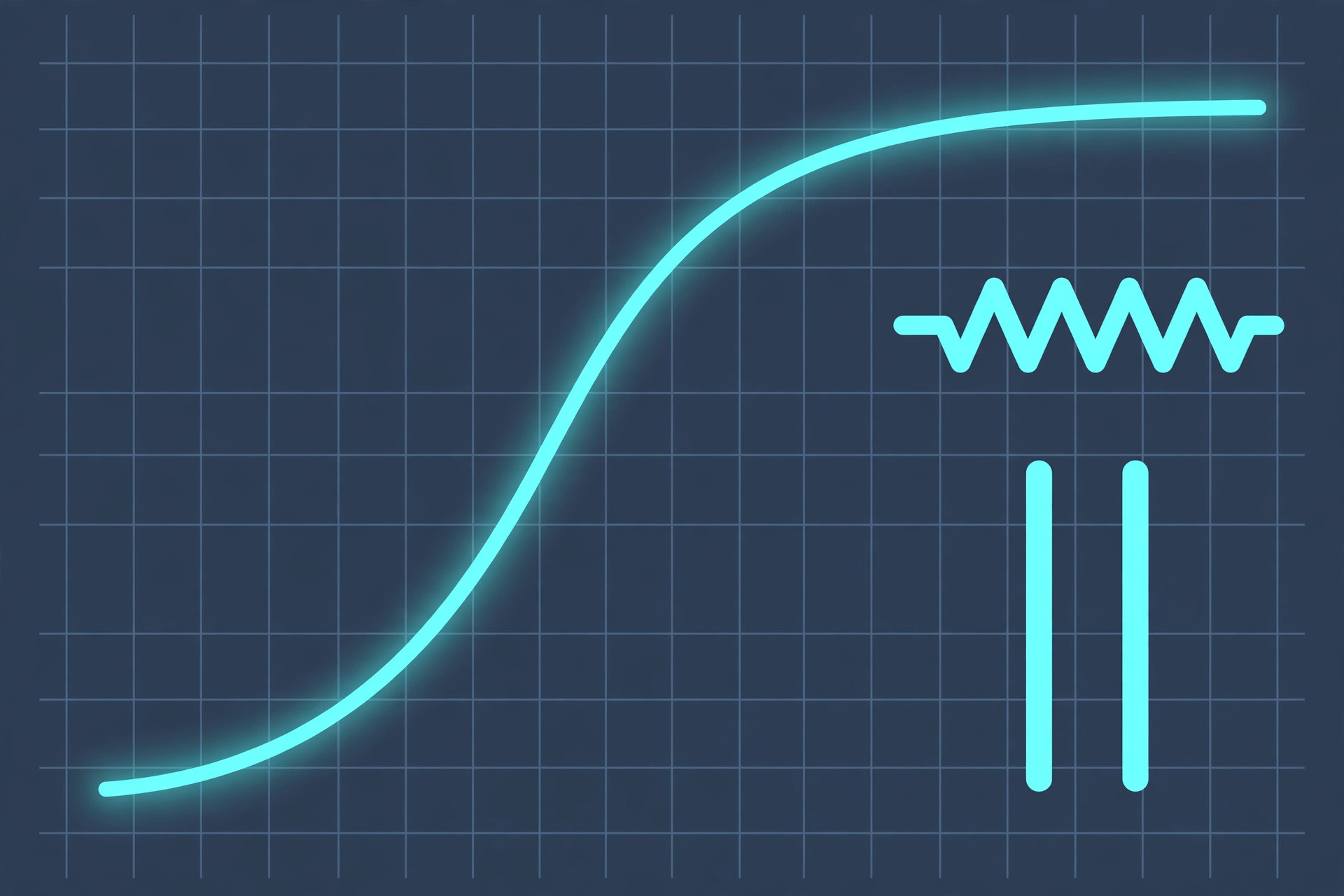
When a capacitor charges through a resistor, the voltage does not climb in a straight line. It follows an exponential curve whose pace is set by a single figure, the time constant, tau, equal to R times C in seconds. After one time constant the capacitor reaches about 63 percent of the supply. After two, about 86 percent; after three, 95 percent; after five, over 99 percent, which engineers treat as fully charged. Discharge mirrors the curve exactly, falling to 37 percent in the first time constant. The curve's shape is the same whatever the values: only the time scale stretches or shrinks.
Where you meet it every day
The time constant is the hidden metronome of electronics. It sets how long a reset circuit holds a microcontroller down at power-up, how a debounce circuit ignores switch bounce, and the flash rate of the classic 555 timer. In audio, an RC pair at the input of an amplifier blocks DC while passing the signal, and its time constant decides how much bass survives. Power supply designers check it in reverse: the smoothing capacitor and load form a discharge curve between mains peaks, and the sag on that curve is the ripple voltage. Even a multimeter's slow settling on a high-resistance range is an RC curve introducing itself.
Choosing values with intent
Because tau is a product, the same time constant comes from many pairs: 1 kilohm with 100 microfarads and 100 kilohms with 1 microfarad both give a tenth of a second. The choice between them is practical. Large resistances make circuits sensitive to leakage, stray currents and noise pickup; large capacitances mean electrolytic parts with loose tolerance and slow surprises. Timing circuits therefore live in the middle, kilohms and microfarads, where parts are accurate and currents are healthy. The calculator gives both the time constant and the five-tau settling time, the two figures most often wanted when a delay, a filter or a reset pulse is being designed. The discharge side of the curve earns equal respect. Switch off a circuit and its capacitors do not empty instantly; they decay along the same exponential, which is why a power supply's output fades rather than snaps off, why a camera flash stays dangerous after the battery leaves, and why memory and logic can misbehave during a slow power collapse unless a reset circuit holds them down until the rail is honest. Designers exploit the curve deliberately in watchdog timers, inrush limiters and soft-start circuits that let a rail rise along a tame exponential instead of a step. Whenever a circuit's behaviour involves waiting, ramping or forgetting, look for the resistor and capacitor quietly setting the schedule.
Try the numbers yourself
The free calculator that goes with this guide:
Open the time constant calculator