Inductors Explained: The Coil That Resists Change
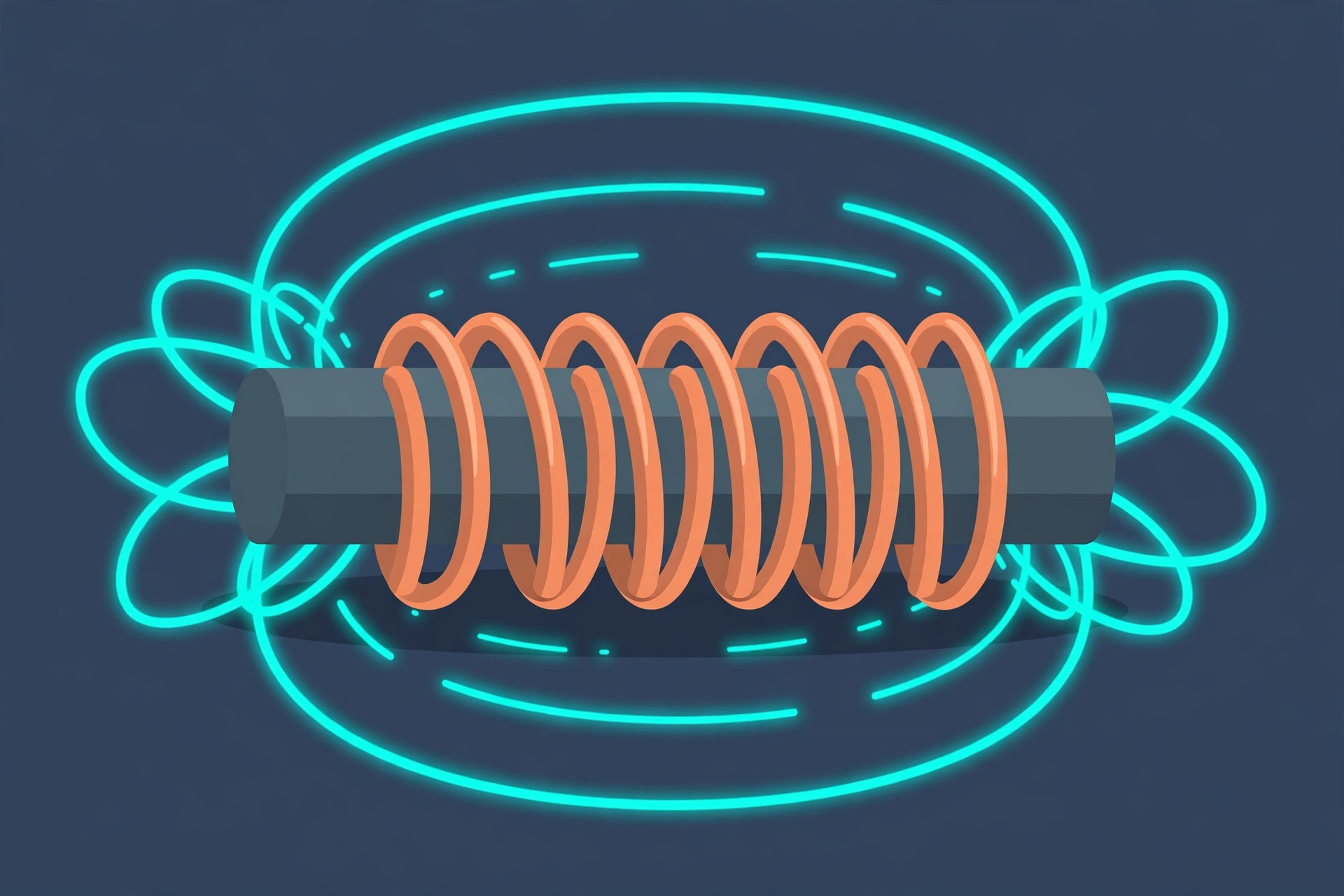
A coil that pushes back
Wind wire into a coil and it becomes an inductor: a component that stores energy in a magnetic field and resists any change in the current through it. Apply a voltage and the current ramps up gradually as the field builds; remove the voltage and the field collapses, driving current onward. Inductance is measured in henries, with millihenries and microhenries doing the everyday work. A core of iron or ferrite concentrates the field and multiplies the inductance, at the cost of saturation: push the current too far and the core can store no more, and the inductance falls away sharply.
Reactance and the frequency bargain
To alternating current an inductor offers reactance, XL = 2 pi f L, which rises with frequency. Direct current passes almost unopposed except for the winding's plain resistance, while high frequencies are choked off. That bargain makes inductors the mirror image of capacitors and partners them in filters, resonant circuits and radio tuning. In power supplies, the inductor in a buck converter smooths the current into a steady flow, storing energy during the switch-on pulse and releasing it during the off time, dozens of thousands of times a second, in nearly every phone charger and laptop.
Spikes, saturation and respect
The same refusal to change current makes inductors dangerous when interrupted: switch off a relay coil or motor suddenly and the collapsing field can generate a spike of hundreds of volts, enough to puncture a transistor. The standard cure is a flyback diode across the coil, giving the current a safe path to die away. Inductors also carry winding resistance that wastes power as heat, and their fields can couple into nearby circuits, which is why layout matters in switching supplies. Treat the stored energy figure, half L I squared, as a measure of how much trouble a coil can cause, and give it a planned path. Measuring inductance catches beginners out, because a standard multimeter cannot do it and the value depends on the conditions: core materials shift with frequency, temperature and the DC current already flowing, which is why datasheets specify inductance at a stated test frequency and bias. Winding your own is practical and satisfying, since inductance follows the square of the turns count, so doubling the turns quadruples the inductance on the same core, a lever with real force. Keep the winding tight and even, respect the core's saturation current, and remember that every inductor is also a resistor and a small capacitor in disguise, its self-capacitance setting a self-resonant frequency above which it stops behaving like an inductor at all.
Try the numbers yourself
The free calculator that goes with this guide:
Open the RL filter calculator