Heat Sinks Explained: Giving Watts Somewhere to Go
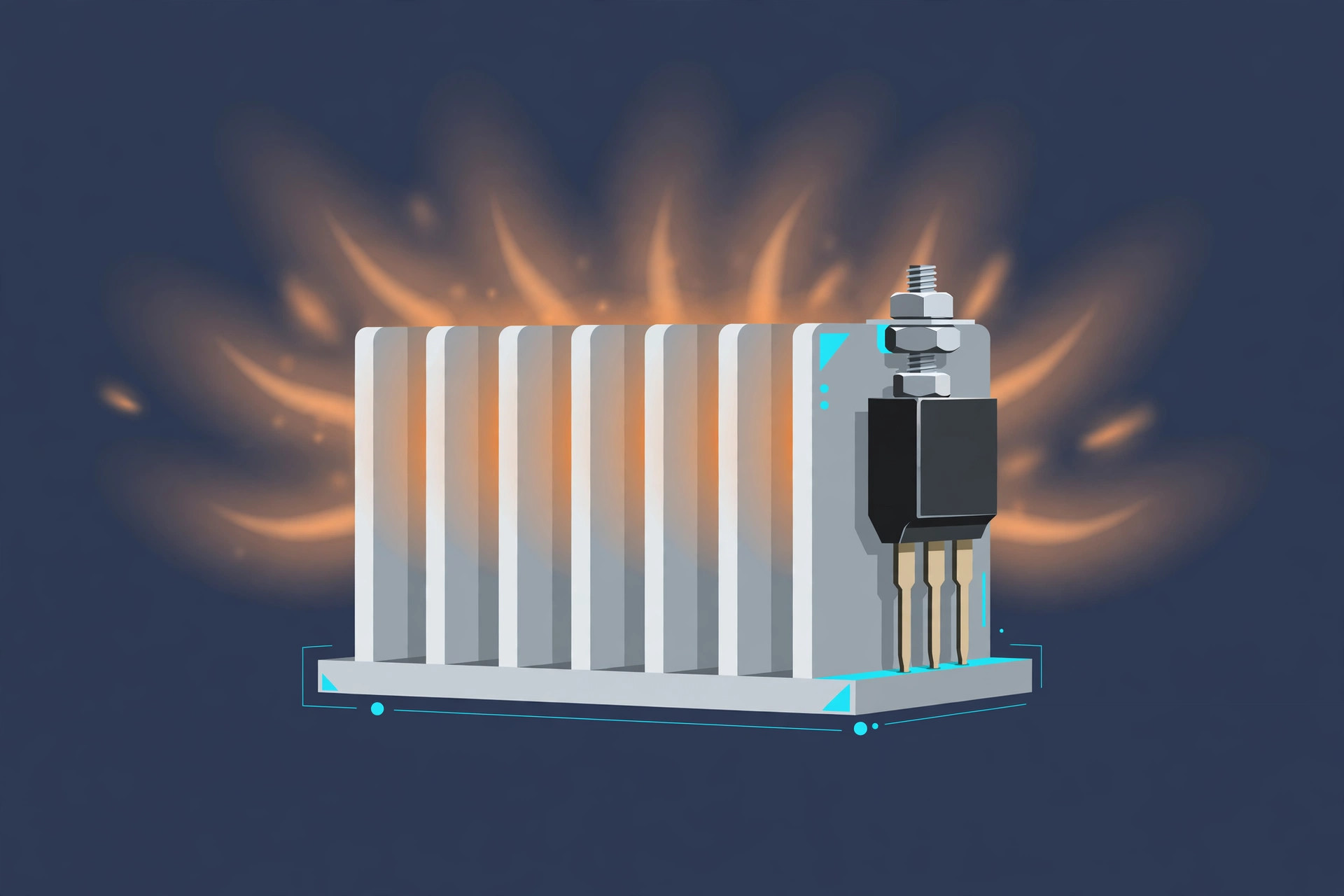
Heat is a flow, temperature is a slope
Every watt a component dissipates must travel to the air or die trying. The path is described in thermal resistances, degrees per watt, chained like electrical resistors in series: junction to case, case to sink, sink to ambient. Multiply the total by the power and you get the temperature rise of the silicon above the room. A transistor dissipating 10 watts through a total of 5 degrees per watt runs its junction 50 degrees above ambient, which in a 35 degree enclosure means 85 degrees inside the part, within sight of many limits. This is Ohm's law in a thermal accent, and it is calculated the same way.
Sizing the sink honestly
Heat sink ratings in degrees per watt are quoted in free air, vertically oriented, with nothing crowding the fins, conditions your enclosure may not offer. Bigger sinks help until the limit becomes the interfaces: a dry, uneven mounting can cost more than the sink saves, which is why thermal paste or pads, flat surfaces and firm, even pressure matter as much as fin area. Black anodising improves radiation slightly; orientation matters more. Fans change the game entirely, cutting a sink's effective thermal resistance several-fold, at the price of noise, power and a moving part that will one day stop moving.
When to calculate and when to measure
The Joule heating calculator gives the power figure that starts every thermal design; the rest is a chain of datasheet numbers and judgment. For anything dissipating more than a watt or two, do the chain sum, choose the sink with margin, then verify on the bench: run the worst-case load until temperatures settle, which can take an hour, and measure the case with a thermocouple or camera. Silicon that lives at 60 degrees outlasts silicon that lives at 110 by years, and the difference is usually a slightly larger piece of aluminium chosen on purpose rather than by hope. Catalogue numbers reward a sceptical eye. A sink rated at 5 degrees per watt in a datasheet graph may reach that only at a particular power and orientation, since natural convection strengthens as the sink warms, making the rating itself temperature-dependent. Altitude thins the air and weakens convection; dust insulates fins with felt; a neighbouring hot component pre-warms the intake. None of this invalidates the thermal chain, it merely moves its constants, which is why experienced designers treat the calculation as a floor for the size and the bench measurement as the verdict. When a product must survive a hot climate inside a sealed box, the sink stops being an accessory and becomes one of the largest mechanical decisions in the design.
Try the numbers yourself
The free calculator that goes with this guide:
Open the Joule heating calculator