Fuses and Circuit Protection: The Deliberate Weak Link
A component designed to die well
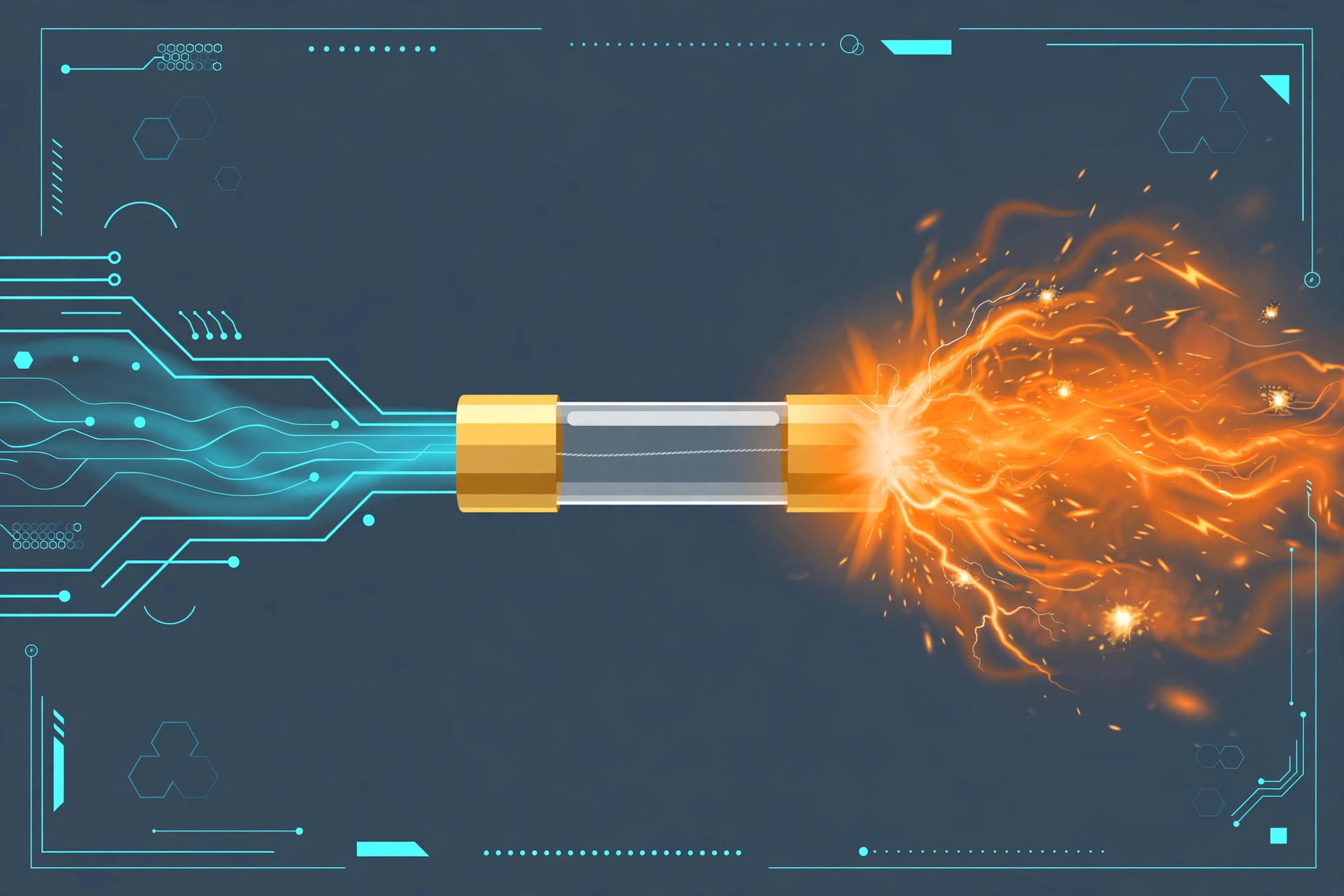
A fuse is a calibrated weak link: a wire or strip sized to melt when current exceeds its rating for long enough, breaking the circuit before the wiring, the insulation or the building does. Its job is not to protect the delicate electronics, which usually die first and fastest, but to prevent fire and limit damage when something has already gone wrong. Fuse behaviour is specified as a time-current curve, because a fuse must tolerate the brief inrush of a motor starting or a capacitor charging, yet open quickly under a genuine fault. Fast and slow-blow types encode that patience difference.
Ratings: current, voltage and breaking capacity
Three numbers matter. The current rating is the carry-forever figure, with blowing beginning somewhere above it on the curve. The voltage rating is the maximum the fuse can safely interrupt; a fuse asked to break a higher voltage may arc across its own remains and fail to clear the fault. The breaking capacity is the largest fault current it can interrupt without exploding, which in mains work near a distribution board can be thousands of amps. Car fuses, glass cartridge fuses and ceramic mains fuses live in different worlds of these numbers, and a physically fitting substitute is not thereby an electrically suitable one.
When a fuse blows, listen to it
A fuse that blows once, at the moment of a obvious event, has done its job. A fuse that blows repeatedly is a messenger: something downstream is drawing fault current, and replacing the fuse with a larger one, or with foil, the oldest and worst improvisation in electricity, silences the messenger while the fault warms up. Find the fault first: shorted rectifiers, tired capacitors, chafed insulation and stalled motors head the list. Size replacements from the original specification or the equipment manual, and keep the Joule heating figures in mind: the fuse protects the cable, and the cable's rating, not the load's appetite, sets the ceiling. Modern protection has added colleagues rather than replacements. Resettable polymeric fuses warm and trip, then recover when the fault clears, suiting them to ports and toys where a service visit is absurd. Electronic fuses and protected switches measure current precisely and open in microseconds, with reporting a melting wire cannot offer. Circuit breakers own the building scale. Yet the glass cartridge endures because its virtues are elemental: it needs no power, works at any orientation, fails open, and its behaviour is physics rather than firmware. Whatever the technology, the principle the fuse teaches stands: protection is a component you design in, with numbers, on purpose, before the fault designs it for you.
Try the numbers yourself
The free calculator that goes with this guide:
Open the Joule heating calculator