Frequency and Wavelength: The Speed of Light Sets the Trade
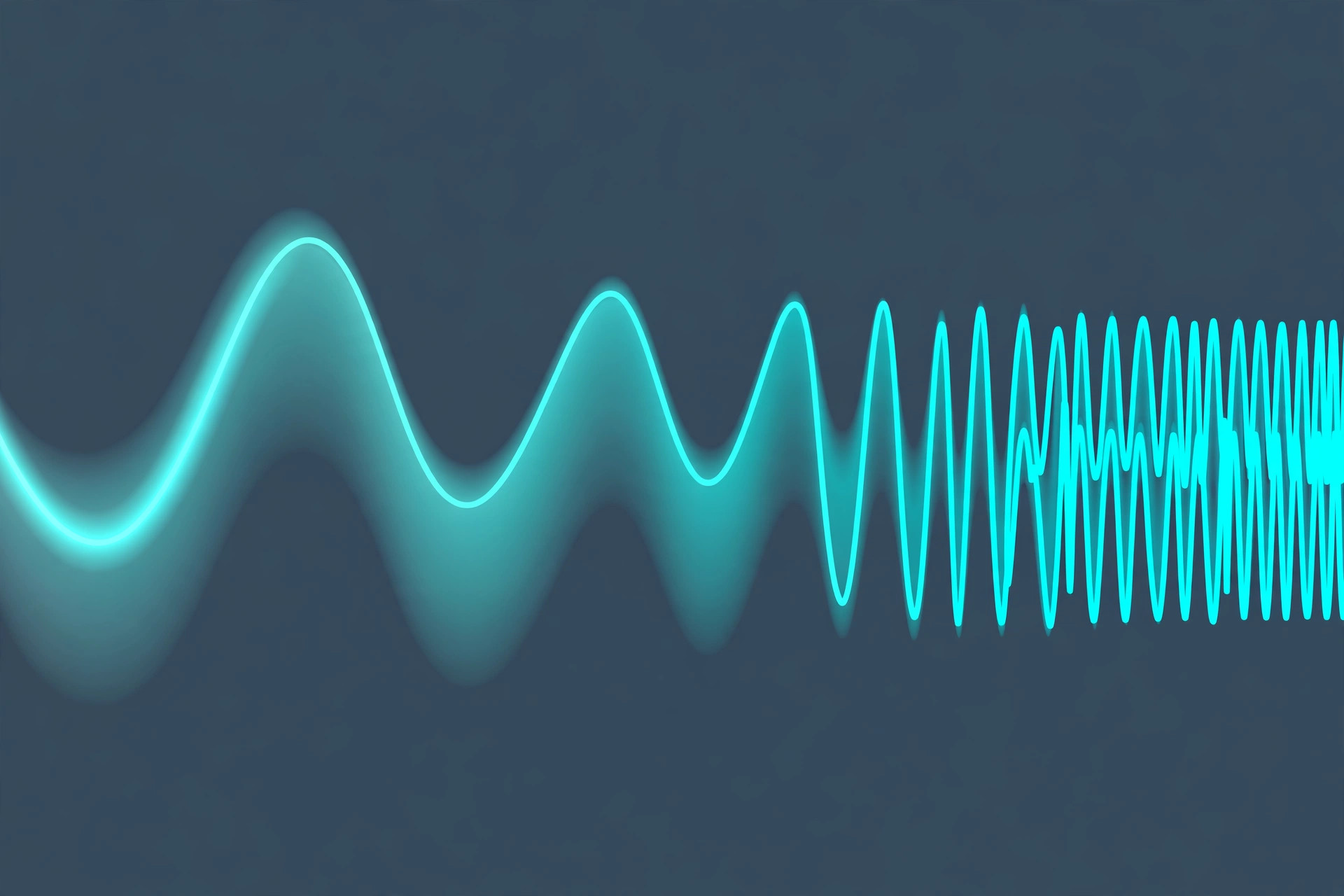
Locked together by the speed of light
Frequency counts how many wave cycles pass each second; wavelength measures the physical length of one cycle. Multiply them and you always get the speed of the wave, for radio waves the speed of light, about 300 million metres per second. So the trade is fixed: a 1 megahertz wave is 300 metres long, a 100 megahertz FM signal is 3 metres, a 2.4 gigahertz Wi-Fi wave is 12.5 centimetres, and a 24 gigahertz radar wave is barely over a centimetre. Every antenna, cable and enclosure in radio work is sized against these lengths, which is why the conversion is a daily habit.
What the length decides
Antennas work when their size is a sensible fraction of the wavelength, so long waves demand long wires: a dipole for the 80 metre amateur band stretches 40 metres, while a phone hides several antennas because at gigahertz frequencies a quarter wave is a couple of centimetres. Long waves also bend around hills and follow the earth's curve, which is why shipping and submarine broadcasts live at very low frequencies with wavelengths of kilometres. Short waves reflect off the ionosphere and circle the globe. Microwaves go in straight lines and carry enormous bandwidth, but rain and walls tax them for it.
In cables, everything slows down
The speed of light figure is for free space. Inside a cable, the wave travels at the velocity factor of the insulation, typically 66 to 85 percent of the free-space speed, so electrical lengths shrink accordingly. Circuit boards do the same, which matters when a trace becomes a meaningful fraction of a wavelength and stops behaving like a simple wire, the moment ordinary electronics turns into radio engineering. The converter here works in free space; multiply by the velocity factor when your wave is travelling in plastic, and remember that a quarter wavelength is the length at which cables start doing unexpected, sometimes useful, things. The relationship also sets the scale of rooms and boards. A concert hall is many wavelengths long at bass frequencies and a small fraction of one at the highest harmonics' shorter reach, which is why low notes ignore furniture and high notes are shadowed by a head. On a circuit board, a trace becomes a transmission line worth worrying about when it approaches a twentieth of the wavelength of the fastest edge it carries, which for modern digital signals with nanosecond edges arrives at a few centimetres, startlingly soon. Radio amateurs carry one conversion in their heads, 300 divided by the frequency in megahertz gives metres, and it sizes everything from garden dipoles to the whip on a handheld, a reminder that wavelength is not an abstraction but a measurement you can pace out.
Try the numbers yourself
The free calculator that goes with this guide:
Open the frequency and wavelength converter