Electromagnetic Interference Basics: Sources, Paths and Victims
Interference is a system, not a gremlin
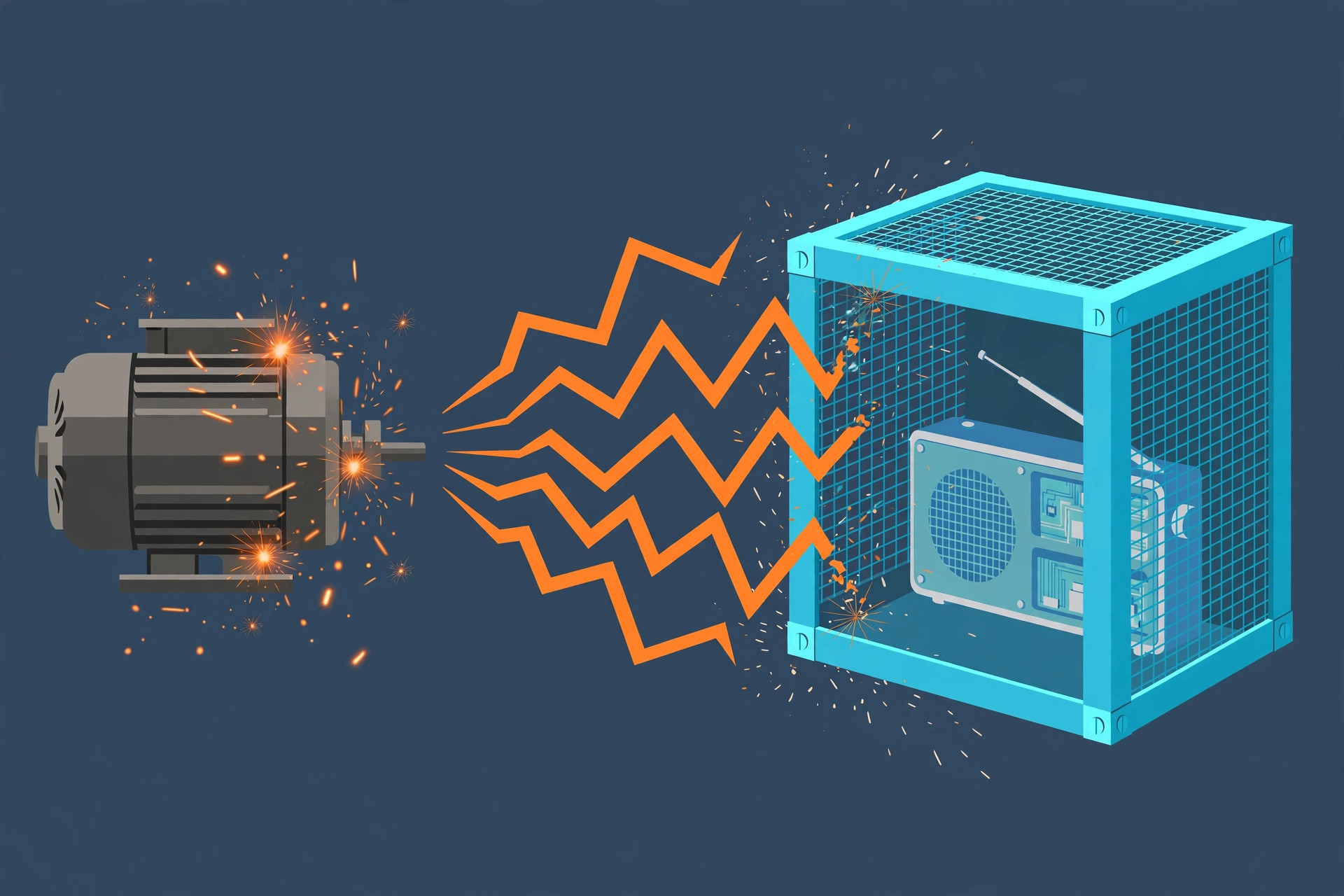
Electromagnetic interference needs three things: a source, a victim and a path between them. Break any leg and the problem ends, which is the entire strategy of EMC engineering. Sources are anything that changes current quickly: motor brushes, relays, switching supplies, digital clocks and their harmonics reaching far up the spectrum. Paths are conduction along shared cables and power rails, capacitive and inductive coupling between nearby wiring, and outright radiation once structures approach a fraction of a wavelength. Victims are sensitive inputs, high-gain amplifiers and radio receivers, though any circuit is a victim at some level of abuse.
The layered defences
Good practice stacks cheap habits. Keep loops small, because loop area is antenna area, for emitting and receiving alike. Return currents beside their outgoing paths, over solid ground planes. Decouple at the pins so fast current gulps circulate locally instead of touring the board. Filter at boundaries, where cables enter a box, because a cable is an antenna with a connector. Shield when the previous layers are not enough, in continuous metal with seams and apertures treated as the leaks they are. Ferrite beads and common-mode chokes absorb what layout could not prevent, and distance, the oldest defence, still works for free.
Debugging the invisible
EMI faults announce themselves sideways: a radio that buzzes when the fridge starts, a sensor that lies when a motor runs, a product that passed every bench test and fails in a metal cabinet. The diagnostic tools are a portable radio, a near-field probe, ferrite clamps tried on one cable at a time, and the discipline of changing one thing and retesting. Regulations require products to pass emission and immunity limits, but the designs that pass easily are the ones that treated interference as physics from the first schematic, not as a surprise at the test house. The frequency and wavelength figures explain why: at 300 megahertz a 25 centimetre cable is a respectable antenna, whether you intended one or not. Regulatory limits give the subject its deadlines, but the physics offers a cheaper timetable: interference is cheapest to kill at the schematic, dearer on the prototype and dearest at the test house with a launch date waiting. A useful mental model is to treat every fast edge as a small transmitter looking for an antenna and every sensitive input as a receiver looking for one too, then refuse to provide either. Where a product must live beside genuine transmitters, immunity is designed the same way in mirror image: filters on every entering wire, watch-dogs and sanity checks in software, and enclosures that assume the storm rather than hope for calm. Quiet is not an accident that happens to good products; it is a specification they were built to.
Try the numbers yourself
The free calculator that goes with this guide:
Open the frequency and wavelength converter