Dipole Antenna Basics: Half a Wavelength of Wire
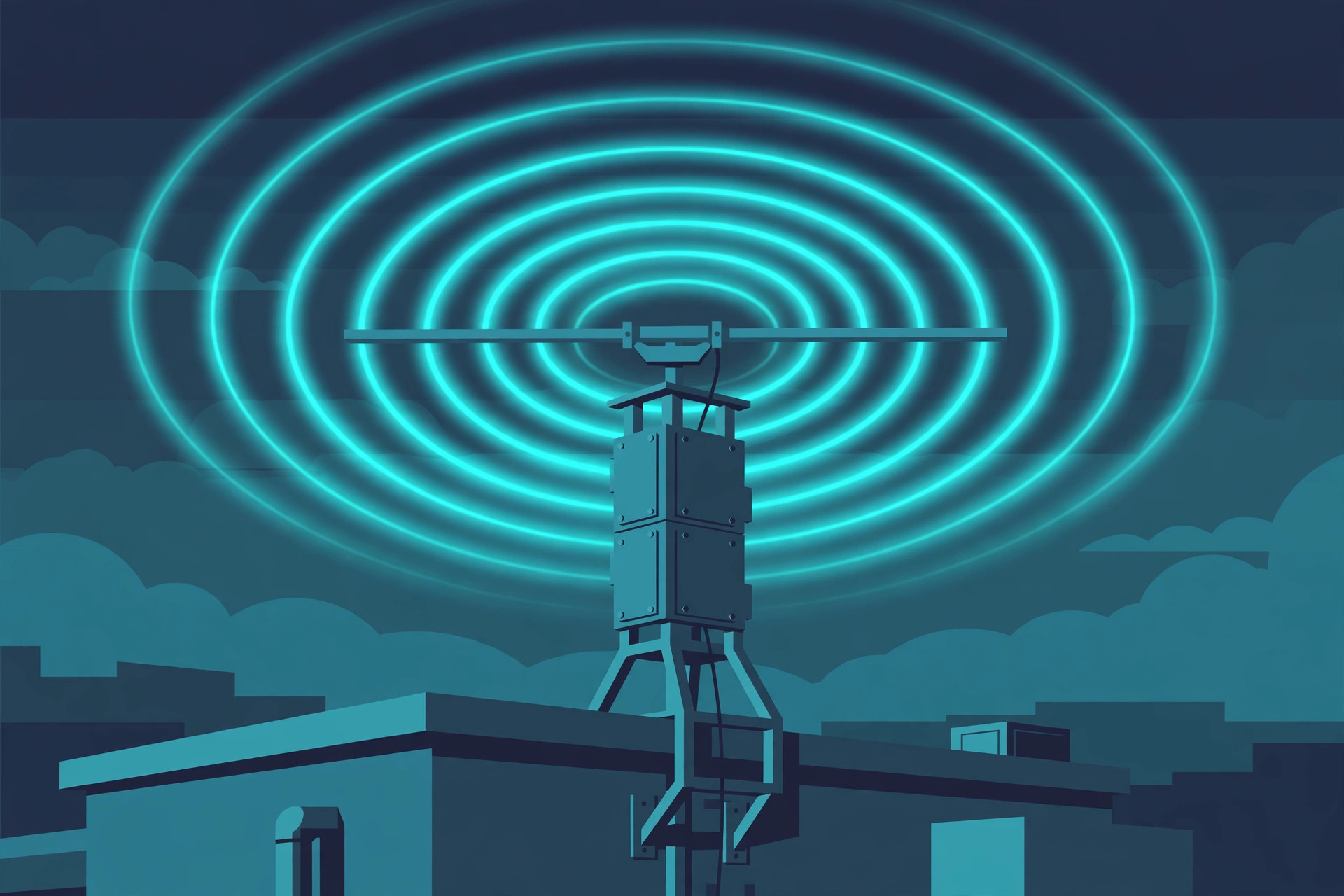
The simplest antenna that works
A dipole is two straight conductors, each a quarter wavelength long, fed at the centre where they nearly meet. At its resonant frequency it presents a comfortable impedance near 73 ohms, close enough to standard 75 and 50 ohm systems to be useful everywhere, and it radiates a tidy doughnut-shaped pattern broadside to the wire. Marconi-era experimenters found it by trial; theory later confirmed it as close to ideal. Because it is simple, predictable and buildable from wire and insulators in an afternoon, the dipole became the reference antenna: gains of other antennas are quoted in dBd, decibels relative to a dipole.
Cutting, feeding and hanging
Length is set by frequency and trimmed by reality. The standard formula gives each leg as a quarter wavelength shortened by the velocity factor of the wire, about 95 percent for bare conductors, and practical builders cut a little long and fold back the ends while watching an SWR meter or a simple field strength check. Feed it with coaxial cable through a balun if you can, to stop the cable itself radiating and bringing interference down into the shack. Height matters: a dipole less than a quarter wave above ground throws much of its energy upward, warming clouds instead of reaching stations, while half a wavelength up gives the classic low-angle pattern for distance.
Variations that fill the bands
Fold the wire back on itself and you get the folded dipole, with four times the impedance and broader bandwidth. Bend the ends down and you have the inverted V, a kindness to those with one tall support. Shorten the legs with loading coils and the dipole fits small gardens at the price of efficiency and bandwidth. Feed it off-centre and several bands share one wire. All of them descend from the same half wave of wire, and the length calculator here gives the starting dimensions for any of them, at any frequency, before the trimming begins. Materials and surroundings finish what the formula starts. Wire diameter matters little to length but much to bandwidth: fatter elements, or cages of several wires, hold their match across more of the band. Insulators at the ends add a touch of capacitance, one reason the 95 percent factor is an average rather than a law. Nearby gutters, roofs and other wires couple to the antenna and shift its resonance, sometimes usefully, sometimes not, which is why two identical dipoles in different gardens peak on different frequencies. None of this makes the starting calculation pointless; it makes it the correct first move, after which an analyser or a patient SWR sweep tells you where your particular sky and soil have moved the truth.
Try the numbers yourself
The free calculator that goes with this guide:
Open the antenna length calculator