Crystal and LC Oscillators: Circuits That Keep Time
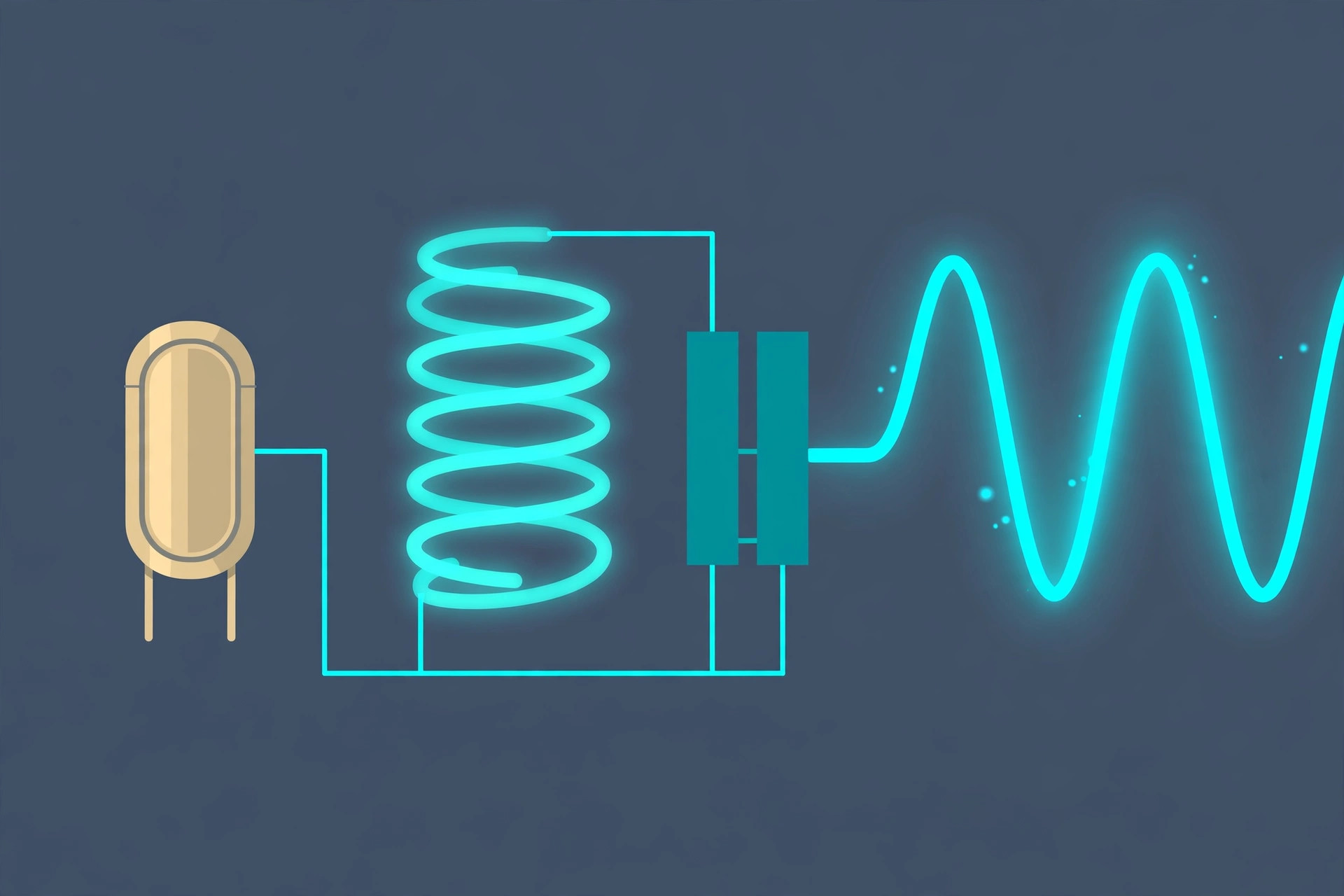
An amplifier feeding its own echo
Every oscillator is an amplifier whose output is fed back in phase at one frequency, loudly enough to sustain itself. Start-up comes free: thermal noise contains every frequency, the resonant circuit selects one, and the loop builds it up until the amplifier's own limits set the level. The LC oscillator uses a resonant tank as the selector, and in its many named forms, Hartley, Colpitts, Clapp, it has generated radio signals since the earliest transmitters. Its frequency is set by the LC resonance formula, and its stability is limited by everything that can nudge L or C: temperature, vibration, ageing and the circuit it feeds.
Quartz: resonance you can machine
A quartz crystal is a sliver of piezoelectric rock that flexes electrically and rings mechanically at a frequency set by its cut and thickness, with a Q thousands of times higher than any LC circuit. That narrow, stubborn resonance is why crystals rule clocks: a watch crystal at 32,768 hertz, chosen because it divides by powers of two to exactly one pulse per second, keeps time to seconds a month. Microcontrollers, radios and computers all tick from crystal or crystal-derived clocks, and their load capacitors, a few picofarads either side, pull the frequency slightly and must be chosen as the datasheet directs.
The stability ladder
Applications climb a ladder of effort. A free-running LC oscillator drifts percent with temperature and suits toys and simple transmitters. A crystal holds parts per million and runs the digital world. Temperature-compensated and oven-controlled crystals buy another factor of ten or a hundred for instruments and base stations. At the top sit atomic standards, and the GPS system that disciplines ordinary oscillators against them from orbit. Choosing where on the ladder a design belongs is a budget decision disguised as physics: the resonance calculator gives the LC starting frequency, and the rest is knowing how still it must stand. Building an LC oscillator that starts every time is its own small discipline. The loop gain must exceed unity at start-up yet settle without distortion, the tank must not be loaded by the stage watching it, and the layout must keep the output's harmonics out of the input, or the circuit finds extra frequencies to sing at. Crystals remove most of that drama, which is why even committed radio builders buy their frequency references. When a crystal oscillator misbehaves, the suspects are mundane: load capacitors far from the specified value, too much drive for a small crystal, or a layout that added picofarads the designer never drew. Precision begins as arithmetic and ends as housekeeping.
Try the numbers yourself
The free calculator that goes with this guide:
Open the LC resonance calculator