Back EMF: The Spike That Kills Transistors
The spike that comes from stopping
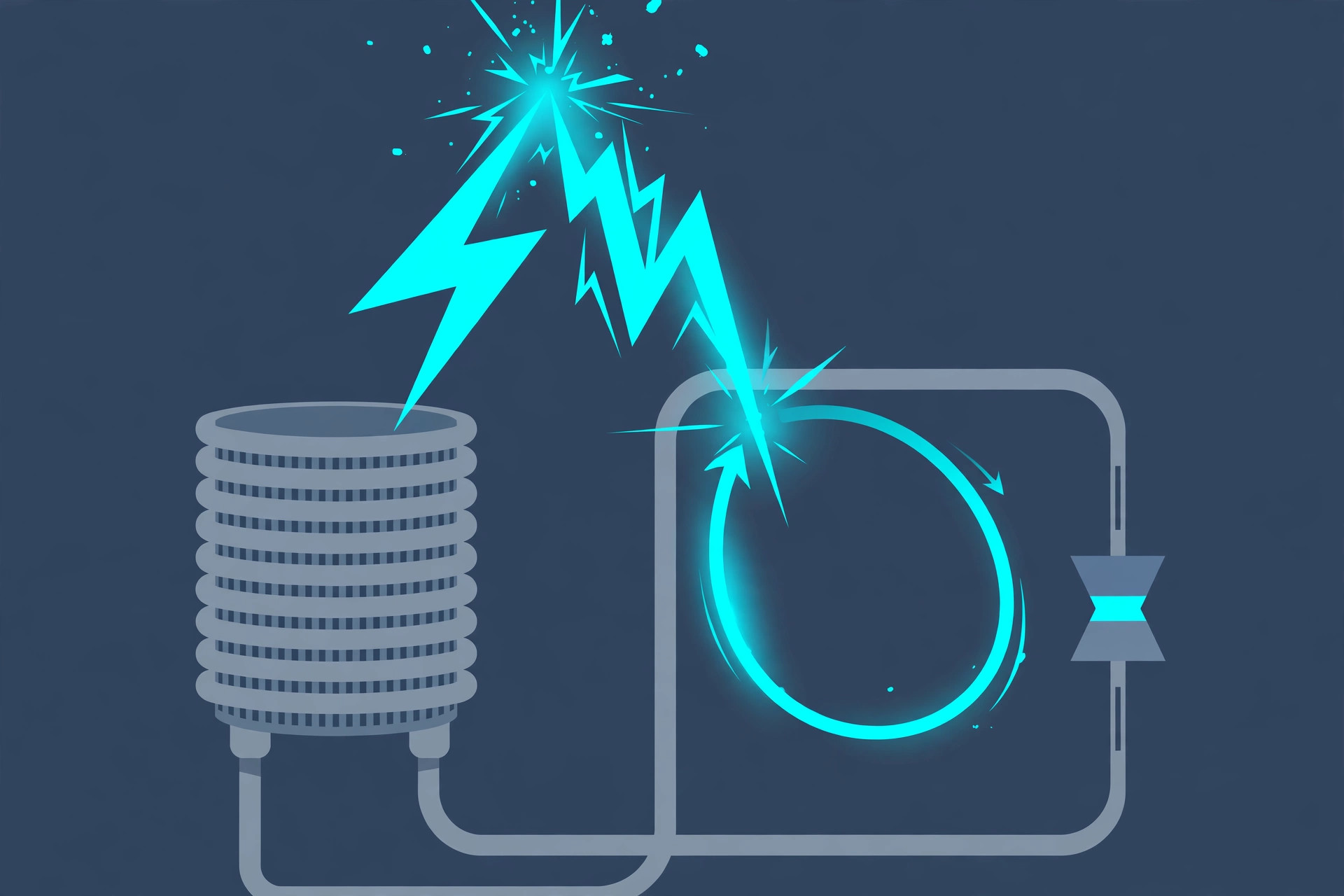
An inductor's current cannot change instantly. While a relay coil, solenoid or motor winding is energised, its magnetic field holds energy, half L I squared. Open the switch and the current has nowhere to go, so the collapsing field drives the voltage at the coil terminals upward, hunting for any path: across the switch contacts as an arc, through a transistor as a fatal punch-through, or into nearby wiring as interference. Spikes of hundreds of volts from a modest 12 volt coil are routine. This is back EMF, and it is also, used deliberately, the working principle of the ignition coil that fires a petrol engine's spark plugs.
The flyback diode, one part that saves many
The standard cure costs pennies: a diode wired across the coil, reverse-biased in normal operation so it does nothing, and forward-biased the instant the coil voltage reverses at switch-off. The coil current then circulates through the diode and decays gently as heat in the winding resistance. The diode must carry the full coil current briefly and stand off the supply voltage, both easy specifications to meet. The trade-off is a slightly slower release of relays and solenoids, because the current decays gradually; where release speed matters, a zener in series with the diode burns the energy faster at a controlled higher voltage.
Finding back EMF damage in the wild
Back EMF failures have a recognisable signature: driver transistors that die shorted, switch contacts pitted and welded, microcontrollers that reset when a motor stops, and radio interference timed to a solenoid's click. If a design worked on the bench and fails in the field, look for the coil without a diode. Modern parts increasingly integrate the protection, but the physics has not changed and neither has the fix. The inductor energy calculator tells you how much energy each switch-off has to dispose of; multiply by operations per second and you have the power your protection must quietly absorb, year after year. The spike has a creative side worth knowing. Because the voltage an inductor can generate is limited mainly by how fast its current is interrupted and what path it finds, the same physics steps voltage up in boost converters, where a switch deliberately interrupts the current and a diode steers the resulting pulse into an output capacitor at higher voltage. Every phone charger and LED driver that raises voltage is back EMF on a leash, switched tens of thousands of times a second. The difference between a spike that destroys and a pulse that powers is entirely a matter of giving the current a designed path and a scheduled moment. Suppression and conversion are one phenomenon with two intentions.
Try the numbers yourself
The free calculator that goes with this guide:
Open the inductor energy calculator