AWG Wire Gauge Explained: The Scale Where Bigger Means Thinner
A scale built on ratios, not inches
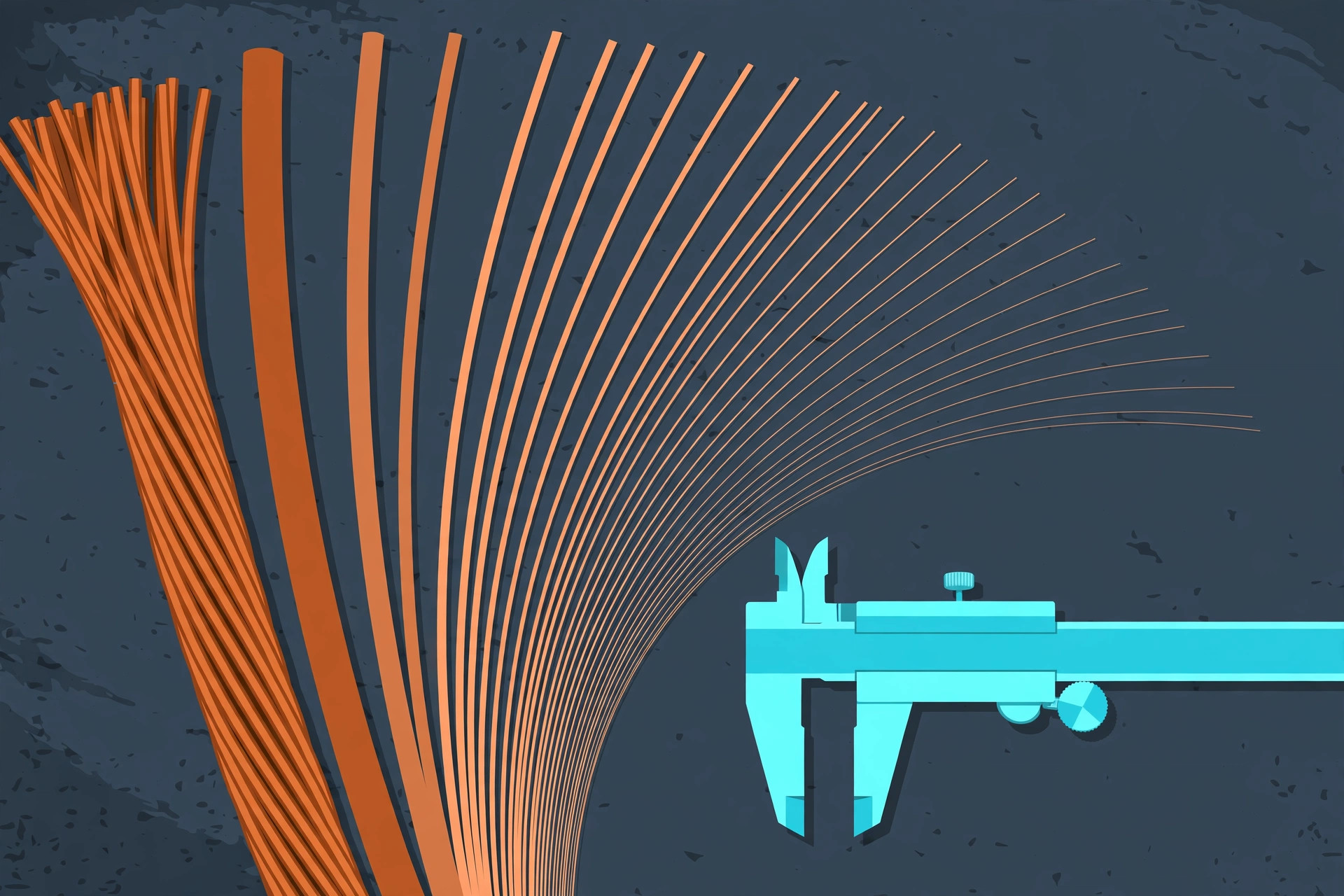
American Wire Gauge dates from the drawing dies of the nineteenth century: the gauge number counted how many dies the wire had been pulled through, so more pulling meant thinner wire and a bigger number. The result is a geometric scale. Every step changes the diameter by the same ratio, about 12 percent, which produces two rules worth memorising: three gauges doubles or halves the cross-sectional area, and six gauges doubles or halves the diameter. Forty gauges span from the 11 centimetre-scale bulk of 0000 down to hair-fine 40 gauge, all from one ratio repeated.
Converting without the table
The diameter follows a formula, 0.005 inches times 92 to the power of (36 minus AWG) over 39, which the converter here evaluates along with the metric diameter, the cross-section in square millimetres and the copper resistance per kilometre. Resistance is the figure with daily uses: it turns a gauge and a length into a voltage drop prediction, and it explains why the last metres of a speaker cable or a solar run are specified in gauges rather than good intentions. Solid and stranded wire of the same gauge carry the same copper area; the stranded version is simply more flexible and slightly fatter overall.
Ampacity: the number that depends
How much current a wire may carry is not a property of the wire alone. It depends on the insulation's temperature rating, whether the wire runs in free air, a bundle or a conduit, and the wiring code of the country and the application: chassis wiring tables allow far more than house wiring tables for the same gauge, because the assumptions differ. Any single ampacity figure quoted without those conditions is a guess wearing a uniform. Use the converter for size and resistance, then take current ratings from the table that matches your insulation, installation and code, with margin for the warm day and the long run. Two neighbouring systems complete the picture. British Standard Wire Gauge is close in spirit but not interchangeable, a trap in old equipment and old books. Metric practice simply states the cross-section in square millimetres, which is the most honest system of all, since area is what resistance and current capacity actually follow, and the converter gives it directly. When a project crosses systems, convert by area, never by the nearest-looking number, and remember that flexible cords are rated by their copper area under names that vary by continent. A micrometer and the diameter formula settle arguments that catalogues cannot, and a short sample measured for resistance settles the rest.